

Table of Contents
The solo exhibition The Body as Art: Form, Space, Light and Female Presence runs from March 10 through March 20, 2026
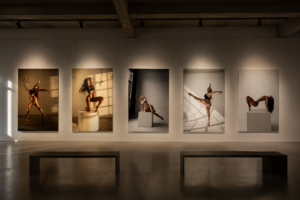
From March 10 through March 20, 2026, photographer Valeriia Guznenkova presents her solo exhibition, The Body as Art: Form, Space, Light and Female Presence. The project continues the artist’s long-term exploration of the female body, visual perception, and the search for a new language within contemporary photography.
At the center of the exhibition is an idea that has come to define Guznenkova’s work: the female body should not exist in photography solely as an object of beauty, desire, or judgment. It can be seen differently—as form, architecture, movement, history, strength, and an independent artistic statement.
In the works presented in The Body as Art, the body enters into a dialogue with light and space. The curve of a back becomes a line; the position of the arms establishes the direction of the composition; a shift in weight creates balance or intentional tension; and light reveals the volume, texture, and plasticity of the human figure. The woman does not simply exist within the frame—her presence determines its visual architecture.
This distinction is fundamental to Guznenkova’s practice. She rejects the idea of a single “correct” female body and the habit of altering a person to satisfy the demands of a photograph. Age, body type, skin texture, physical strength, softness, movement, and individuality are not treated as qualities that need to be concealed. On the contrary, these differences allow each woman to develop her own visual language.
From Being in Front of the Camera to Creating Her Own Method
Valeriia Guznenkova’s personal journey makes this position particularly meaningful. Before becoming a photographer, she spent years experiencing the camera from the other side through modeling and fitness culture. This gave her a firsthand understanding of the distance that can exist between a real person and the image photography creates of them.
Later, when she moved behind the camera, Guznenkova began developing an approach of her own. She was no longer interested in forcing a woman to conform to a flattering angle or an established visual standard. Instead, she began asking a different question: how can an image be constructed around the individual form of a particular person?
Years of professional practice gradually developed into a system of research and ultimately into the Guznenkova Method—her original methodology for visual image construction through form, space, line, balance, movement, and perception. Guznenkova later formalized this approach in her book, The Guznenkova Method: Visual Image Construction Through Form, Space, and Perception, transforming years of practical observation into a structured professional framework for photographers.
Guznenkova is therefore not only the creator of photographs, but also the creator of a way of thinking about photography. Her work speaks directly to other professionals who want to move beyond the technically correct image and understand why a photograph works, how the viewer’s attention travels through it, how the body interacts with space, and how these relationships can be intentionally constructed before the shutter is released.
Her influence consequently extends beyond her individual artistic practice. Through her methodology, research, publications, book, and educational work, Guznenkova is building a professional environment around these ideas and becoming a point of reference for photographers searching for a more intentional and sophisticated language for representing the human body.
At the same time, her photography has become a point of connection for women themselves. At the heart of Guznenkova’s philosophy is a refusal to accept the idea that a woman must first be “corrected” before she can become worthy of a powerful photograph. In her visual world, a woman already possesses form, history, individuality, and artistic value. The photographer’s responsibility is to recognize these qualities and know how to construct an image around them.
Art Beyond Sexualization
A defining aspect of The Body as Art is its departure from the automatic sexualization of the female body. Guznenkova does not reject sensuality, nor does she attempt to remove emotion or physicality from the body. She does something more complex: she refuses to treat sexuality as its primary visual purpose.
A body can be sensual and powerful at the same time. It can be exposed without becoming an object. It can be vulnerable without appearing weak. It can exist within photography as sculpture, line, movement, rhythm, space, and human presence.
It is here that the exhibition moves beyond an aesthetic project and becomes a professional statement about photography itself.
Guznenkova proposes changing not the woman standing in front of the camera, but the way the photographer looks at her.
That distinction becomes one of the central ideas of the entire series.
Instead of asking, “How can I make this body more beautiful?” the photographer begins to ask, “What is the visual nature of this form?”
Instead of “What should be hidden?”—“What should be seen?”
Instead of attempting to bring a person closer to an existing visual standard, photography can construct an image around individuality.
Through this shift, photography ceases to function as a tool of correction and becomes a medium of observation, understanding, and artistic construction.
The Body as Art
The title of the exhibition becomes, in this sense, its manifesto.
The Body as Art does not suggest that a photographer has the power to transform a particular body into a work of art. It proposes almost the opposite: the artist relinquishes the authority to decide which body is sufficiently perfect, young, slender, or visually striking to deserve artistic attention.
For Valeriia Guznenkova, art begins somewhere else—with the ability to see.
Throughout the exhibition, a woman becomes both person and form, character and composition, physical presence and visual architecture. Light does not conceal her; it explores her. Space does not function merely as decoration; it interacts with the body. Posing does not exist to disguise imperfections; it becomes an instrument for constructing the image.
For this reason, The Body as Art: Form, Space, Light and Female Presence can be understood not only as Valeriia Guznenkova’s solo exhibition, but also as a concentrated expression of her professional philosophy.
She invites viewers to look at the female body without immediately feeling the need to evaluate it.
And she invites photographers to consider their own responsibility for how they teach other people to see.
In a world saturated with images and increasingly sophisticated tools for altering them, Guznenkova returns attention to the very beginning of the photographic process—to the human eye, the decision, and the intention behind the image.
Perhaps this is why the central idea of the exhibition ultimately extends far beyond photography:
The female body does not need to become art. It already is.
Visit The Body as Art Online → https://beartnewyork.tilda.ws/guznenkova
By Veronika Katz